In today’s hyper-connected economy, corporate data is an organization’s most valuable—and vulnerable—asset. With ransomware waves scaling and supply-chain vulnerabilities multiplying daily, treating data protection as an isolated IT checklist is no longer sufficient. True cyber resilience requires an embedded system of continuous corporate data protection.
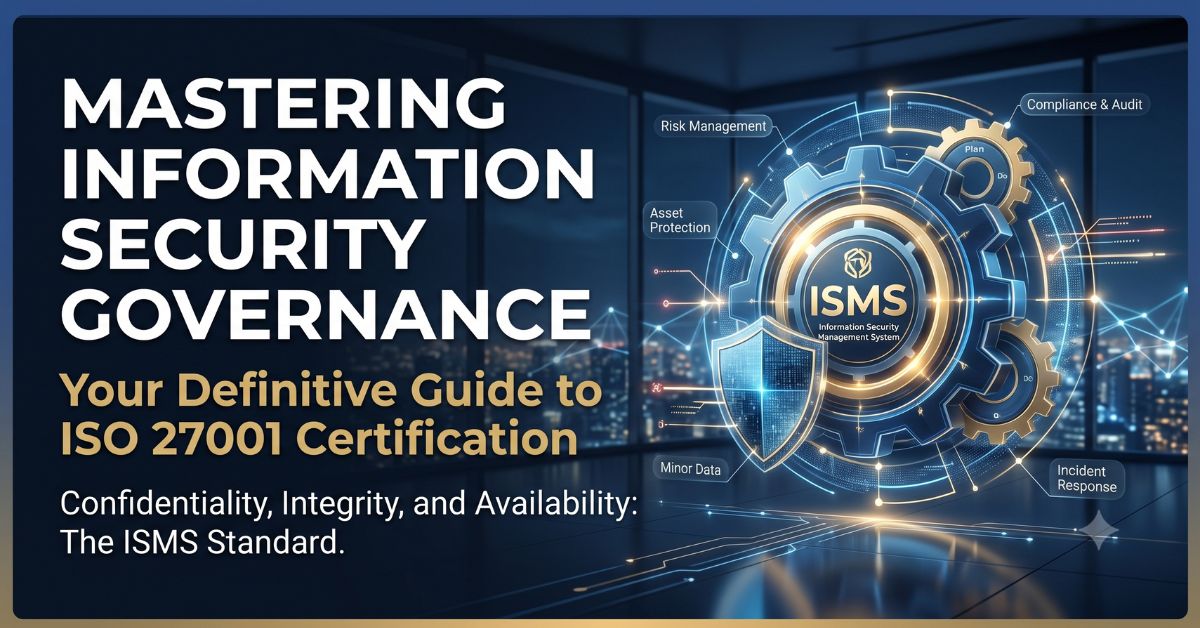
To establish defense-in-depth credibility, progressive enterprises rely on the gold standard of operational trust: ISO 27001 certification. This globally recognized standard maps out the precise operational framework needed to establish, sustain, and systematically mature an Information Security Management System (ISMS).
What is ISO 27001?
ISO 27001 is an international standard that defines the prescriptive requirements for an Information Security Management System (ISMS). It provides an ongoing risk management architecture to protect corporate data assets across three primary vectors: confidentiality, integrity, and availability.
Unpacking the ISO 27001 ISMS Framework
The ISMS framework acts as an operational blueprint that looks beyond software installations. It recognizes that true corporate data protection requires a structured intersection of people, physical processes, and software tools. The newest update, ISO/IEC 27001:2022, natively streamlines the modern technology posture—organizing 93 core controls into 4 thematic operational buckets:
| ISO 27001 Control Domain | Core Areas of Application | Operational Impact |
| Organizational Controls | Information security policies, remote working guidelines, cloud asset accountability. | Clear governance alignment. |
| People Controls | Comprehensive onboarding screenings, continuous security awareness training. | Eliminates insider threats. |
| Physical Controls | Facilities perimeter monitoring, secure equipment positioning, environmental safety. | Prevents localized asset intrusion. |
| Technological Controls | Network perimeter access controls, cryptography management, data masking, secure coding. | Defends against external cyber attacks. |
Compounding Business Benefits of ISO 27001 Compliance
Pursuing ISO 27001 compliance is a direct business accelerator rather than a back-office compliance cost:
- Shatter Enterprise Sales Friction: Attaining an independent ISO 27001 certification immediately bypasses lengthy, complex enterprise security questionnaires, allowing deals to close significantly faster.
- Regulatory Shielding: Fulfilling standard criteria fundamentally serves as an operational bridge to automatically cover compliance requirements for GDPR, HIPAA, and industry-specific mandates.
- Structured Risk Remediation: Running a formal cybersecurity risk assessment empowers enterprise executives to spend security budgets intentionally where real threats reside, avoiding costly technical shelfware.
- Drastic Downtime Reduction: Enforcing strict incident-response controls minimizes operational business disruption if a threat actor attempts to breach your infrastructure boundary.
The Execution Roadmap to Certification Success
Transitioning from a chaotic security posture to an auditable system is achieved in five core phases:
- Scope & Gap Determination: Map out exactly where sensitive data lives inside your networks and benchmark your current defenses against the standard’s Annex A requirements.
- Formal Cybersecurity Risk Assessment: Catalog possible threat actors, systemic tech vectors, and process vulnerabilities, assigning exact impact scores to establish risk treatment plans.
- Control Deployment & Documentation: Write clear operational protocols and enforce necessary safeguards such as multi-factor authentication (MFA) and incident tracking templates.
- Internal Audits & Process Stress Testing: Execute a simulated review to challenge your controls and gather evidence showing that your systems behave exactly as written.
- Independent External Audit: Submit your system logbooks and procedural evidence to an accredited third-party registrar to receive your valid registration seal.
Frequently Asked Questions
Q1: How long does it take to secure an ISO 27001 certification?
Ans: For small to medium-sized organizations, typical implementation timelines range from 4 to 9 months, depending heavily on preexisting data data maturity levels and available engineering resources.
Q2: What is the primary difference between ISO 27001 and SOC 2?
Ans: ISO 27001 is a prescriptive, internationally certified framework for an ongoing security management system, whereas SOC 2 is an independent auditor’s report benchmarking system controls against specific Trust Services Criteria within the US market.
Q3: How long is an ISO 27001 certificate valid for?
Ans: The official certification runs for a 3-year term. However, the organization must pass lighter mandatory surveillance audits during Years 1 and 2 to ensure the ISMS hasn’t degraded.
Conclusion: Turn Information Security Into Market Leverage
Modern buyers do not trust verbal promises; they demand verified operational evidence. Successfully securing an ISO 27001 certification signals to clients, partners, and regulators that you take data preservation seriously. Don’t wait for an operational threat or a compliance penalty to dictate your security posture—standardize your defenses and secure your growth path today.