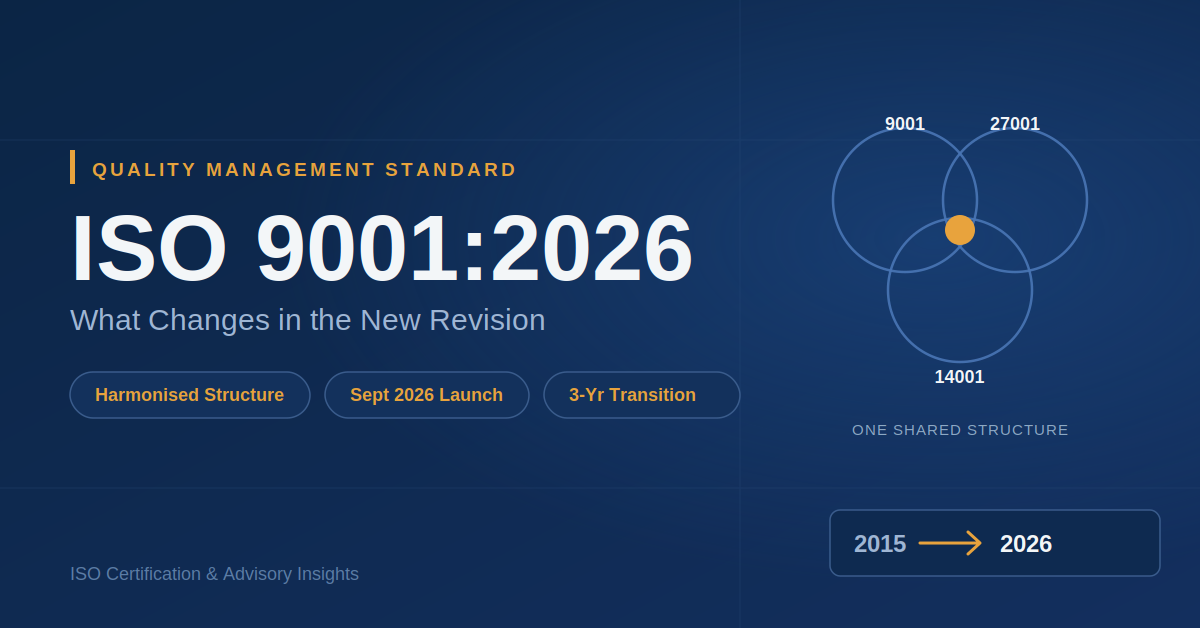
ISO 9001:2026 is the upcoming revision of the world’s most widely adopted quality management system (QMS) standard, replacing ISO 9001:2015 after more than ten years. It is expected to be officially published in September 2026. The biggest structural change is the adoption of the Harmonised Structure (HS), which aligns ISO 9001 with other management system standards like ISO 27001 and ISO 14001. Certified organizations will get a three-year transition period after publication to upgrade, and existing ISO 9001:2015 certificates remain valid until then. No immediate action is required, but early preparation gives certified companies — and the consultants who support them — a clear competitive advantage.
Why This Update Matters
If your organization holds an ISO 9001:2015 certificate, or you’re planning to get certified soon, this is the most significant change to quality management requirements in over a decade. ISO 9001 is the global benchmark for quality management systems, used by millions of organizations across manufacturing, IT, healthcare, education, and services worldwide — including a growing number of Indian MSMEs and enterprises.
Understanding what’s changing now — before the standard is even finalized — puts businesses ahead of the curve instead of scrambling during the transition window.
What Is ISO 9001:2026?
ISO 9001:2026 is the next scheduled revision of ISO 9001, the international standard for quality management systems (QMS), published by the International Organization for Standardization (ISO). The current version, ISO 9001:2015, has been in place since 2015 — ISO standards typically get reviewed roughly every five years, but this revision has taken longer due to the scale of structural alignment involved.
Key Changes in ISO 9001:2026
1. Adoption of the Harmonised Structure (HS)
The most fundamental change is a shift to ISO’s new Harmonised Structure, the successor to the older “Annex SL” framework that standardized the structure of management system standards. This is the same structural framework already used by ISO/IEC 27001 (information security) and other modern ISO standards.
Why it matters: Organizations that hold multiple ISO certifications (for example, ISO 9001 for quality and ISO 27001 for information security) will find it significantly easier to run an integrated management system, since clause numbering, terminology, and core requirements will follow a common pattern across standards.
2. Climate Change Considerations Built Into the Standard
For the first time, ISO 9001:2026 explicitly requires organizations to consider climate change as a relevant factor when determining the context of their quality management system — not as a separate environmental standard, but as part of core quality planning.
3. Risks and Opportunities Are Now Separated
ISO 9001:2015 grouped “risks and opportunities” together under one broad requirement. The 2026 revision splits these into distinct sections, pushing organizations to identify and act on opportunities for improvement with the same rigor previously reserved for risk mitigation.
4. Quality Culture and Ethics as a Leadership Requirement
Top management will now have an explicit responsibility to foster a quality-focused culture and ethical conduct across the organization — moving quality from a procedural checkbox to a leadership and culture mandate.
5. Stronger Link Between Quality Policy and Business Strategy
The revision requires the organization’s quality policy to be clearly aligned with its overall strategic direction, rather than existing as a standalone document disconnected from business goals.
6. Mostly Editorial, Not a Structural Overhaul
Aside from the Harmonised Structure shift, ISO has confirmed most other changes are editorial clarifications rather than a complete rewrite of requirements — meaning organizations with mature QMS implementations won’t need to rebuild from scratch.
ISO 9001:2026 Timeline
| Milestone | Expected Timing |
| Draft/committee stage | Ongoing (2025–2026) |
| Official publication | September 2026 |
| Transition period for certified organizations | 3 years from publication |
| Final deadline to transition existing certificates | Typically aligned with each organization’s recertification audit cycle |
Important: Existing ISO 9001:2015 certificates remain fully valid right now. There is no need for immediate re-certification — but planning ahead avoids last-minute pressure closer to the transition deadline.
Who Is Affected by ISO 9001:2026?
- Organizations currently certified to ISO 9001:2015
- Businesses in the process of first-time ISO 9001 certification
- Companies holding multiple ISO certifications (9001 + 27001 + 14001, etc.) who will benefit most from the Harmonised Structure
- ISO consultants, auditors, and certification bodies preparing training and transition support for clients
How Should Businesses Prepare?
- Don’t panic — but don’t ignore it either. Your current certificate is valid. Use the runway before September 2026 to plan, not react.
- Audit your current QMS documentation against the anticipated structural changes, especially around risk/opportunity separation and climate-related context.
- Review your quality policy and ensure it visibly connects to your business strategy — this will be a documented requirement.
- Talk to your ISO certification consultant or certification body about a transition roadmap once the final standard is published.
- If you’re multi-certified (e.g., ISO 9001 + ISO 27001), start mapping how a Harmonised Structure could simplify your integrated audits and documentation.
Frequently Asked Questions
When will ISO 9001:2026 be officially released?
ISO 9001:2026 is expected to be published in September 2026, based on the current revision timeline.
Do I need to recertify immediately once ISO 9001:2026 is published?
No. Organizations typically get a three-year transition period after publication to move from ISO 9001:2015 to the new version, usually timed with their regular recertification audit.
Is ISO 9001:2026 a complete rewrite of the standard?
No. Apart from adopting the Harmonised Structure, most changes are editorial clarifications rather than a full overhaul of core requirements.
What is the Harmonised Structure in ISO 9001:2026?
The Harmonised Structure is a common framework for organizing ISO management system standards, already used in standards like ISO 27001. It standardizes clause structure and terminology, making it easier to run integrated management systems across multiple ISO certifications.
Will my existing ISO 9001:2015 certificate become invalid right away?
No. Existing certificates remain valid, and the shift to ISO 9001:2026 will happen gradually through the transition period after the new standard is published.
Need Help Preparing for the ISO 9001:2026 Transition?
Whether you’re maintaining an existing ISO 9001:2015 certification or planning your first certification, our team can help you build a QMS that’s ready for the upcoming revision — with zero disruption to your current operations.
Contact us today for a free ISO consultation